We use storage that the site needs to work: your age confirmation and this choice. If you allow them, we also use Google Analytics 4 to understand how the site is used and Google Ads to measure our advertising, both loaded through the Google tag. Nothing optional is loaded unless you say yes, and you can change your mind at any time with “Cookie settings” at the foot of every page. Cookie Policy.
Necessary Age confirmation and your cookie choice. Always on — the site cannot work without them.Always on
Guide · Odds
Fractional and decimal odds explained for Irish bettors
A price on a racecard or bet slip is two things at once: what a bet would return, and how likely the bookmaker thinks the outcome is. This guide shows how to read fractional odds such as 7/2 and decimal odds such as 4.50, how to convert one into the other, and how to work out a return in euro.
Updated: 3 October 2026For: Readers in Ireland, 18+
i.
What odds tell you
Every price a bookmaker shows does two jobs. It tells you how much a bet would return if it wins, and it signals how likely the
bookmaker considers the outcome. A horse at 10/1 is seen as less likely to win than one at 2/1. A team at 1.30 is a strong favourite; a team
at 6.00 is not.
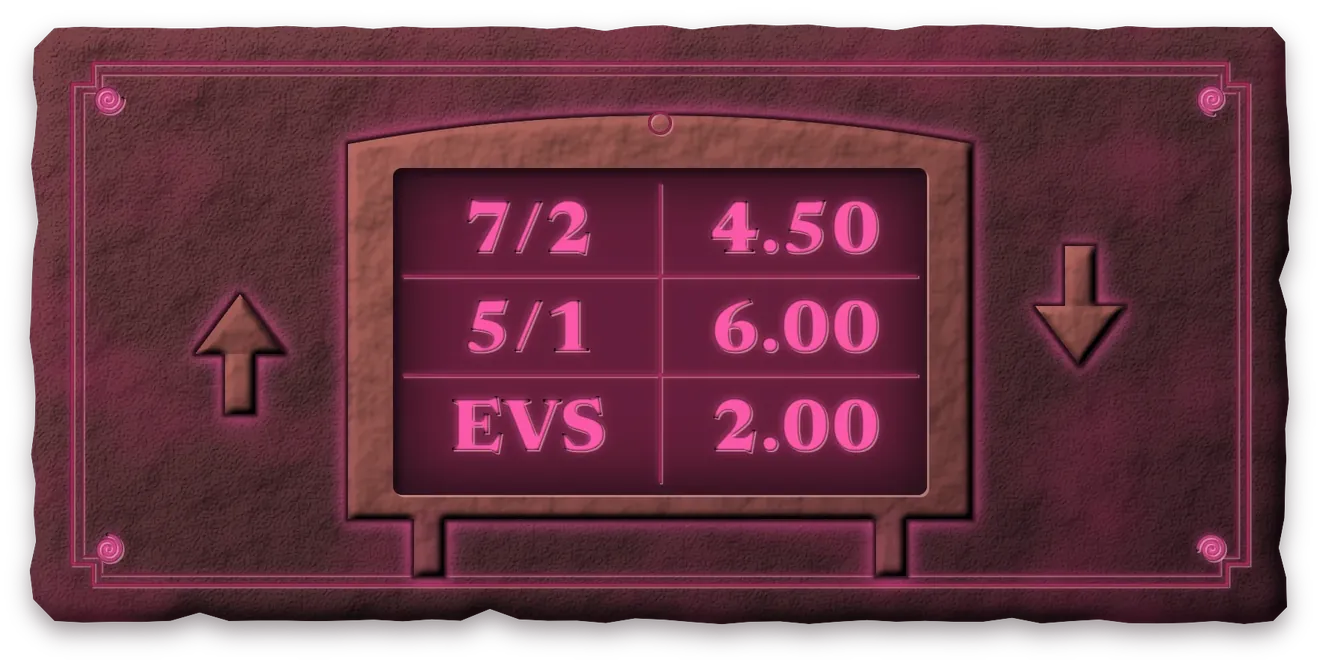
In Ireland you will meet two formats every day. Fractional odds (7/2, 5/1, evens) are traditional in Irish and British
racing and are still used on racecards, in betting shops and by commentators. Decimal odds (4.50, 6.00, 2.00) are common on
betting websites and apps and are often the default there. Most bookmakers let you switch between the two in your account settings.
American odds (+350, −200) turn up now and then, mostly on US sports.
Whatever the format, the price underneath is identical. 7/2 and 4.50 describe exactly the same bet with exactly the same return. Once
that clicks, everything else on this page is simple arithmetic, and the examples use a €10 stake so you can follow the sums.
ii.
Fractional odds
A fractional price compares what you win with what you stake. The number on the right is the stake; the number on the left is the
winnings. At 7/2 (“seven to two”), every €2 staked wins €7 if the bet wins, and your stake comes back on top.
So a €10 bet at 7/2 returns €45 if it wins: €35 in winnings (€10 × 7 ÷ 2) plus your €10 stake. If it loses, the €10 is
gone.
Reading prices aloud
Prices have their own spoken form. 5/1 is “five to one”. 9/4 is “nine to four”. 11/10 is “eleven to
ten”. A short price such as 1/2 is often said as “two to one on”, because the outcome is odds-on. Even money, written
“evens” or “EVS”, means 1/1: you win €1 for every €1 staked.
Why the odd-looking fractions?
Prices such as 11/8, 13/8, 15/8 and 100/30 come from the traditional ladder of prices used on racecourses. They fill the gaps between
round numbers: 13/8 sits between 6/4 and 7/4, and 100/30 is a little longer than 3/1. You don't need to memorise them. Converting to decimal,
as shown below, makes them easy to compare.
The formula
Winnings = stake × (left number ÷ right number). Total return = winnings + stake.
iii.
Decimal odds
A decimal price shows the total return for every €1 staked, with the stake already included. At 4.50, each €1 returns €4.50 if
the bet wins: €3.50 in winnings plus your €1 back.
That makes the sum shorter. Total return = stake × decimal odds. A €10 bet at 4.50 returns €45 if it wins, and the winnings are
€45 − €10 = €35. It is the same result as 7/2, because it is the same price.
Decimal odds are also easier to compare at a glance. 2.63 is clearly bigger than 2.50, which is less obvious written as 13/8 and 6/4. The
smallest decimal price is just above 1.00: at 1.01 you would win one cent for every euro staked. Evens is 2.00, and anything below 2.00 is
odds-on.
The formula
Total return = stake × decimal odds. Winnings = total return − stake.
iv.
American odds, briefly
American (or moneyline) odds use a plus or minus sign around a base of 100. A plus number shows what a €100 stake would win:
+350 means €100 wins €350, the same price as 7/2 or 4.50. A minus number shows what you would need to stake to win €100: −200 means a
€200 stake wins €100, the same as 1/2 or 1.50. Evens is +100.
You will rarely need this format in Ireland. If an app offers it, it converts like this: for plus odds, decimal = 1 + (number ÷ 100);
for minus odds, decimal = 1 + (100 ÷ the number without its minus sign).
v.
Converting between formats
Fractional to decimal: divide the left number by the right number, then add 1. 7/2 becomes 3.5 + 1 = 4.50.
4/6 becomes 0.667 + 1 = 1.67.
Decimal to fractional: subtract 1, then write what is left as a fraction. 3.25 becomes 2.25, which is 9/4. 1.80 becomes
0.80, which is 4/5. Bookmakers round decimal prices to two places, so a converted price can look slightly different: 4/6 shows as 1.67, not
1.666…
The table covers the prices you will see most often. The last column is the implied probability, explained in the next chapter.
Common prices in all three formats (decimal rounded to two places, as bookmakers show them)
Fractional
Decimal
American
Implied probability
1/5
1.20
−500
83.3%
1/4
1.25
−400
80.0%
1/3
1.33
−300
75.0%
1/2
1.50
−200
66.7%
4/6
1.67
−150
60.0%
4/5
1.80
−125
55.6%
10/11
1.91
−110
52.4%
Evens
2.00
+100
50.0%
11/10
2.10
+110
47.6%
6/5
2.20
+120
45.5%
5/4
2.25
+125
44.4%
11/8
2.38
+138
42.1%
6/4
2.50
+150
40.0%
13/8
2.63
+163
38.1%
7/4
2.75
+175
36.4%
15/8
2.88
+188
34.8%
2/1
3.00
+200
33.3%
9/4
3.25
+225
30.8%
5/2
3.50
+250
28.6%
11/4
3.75
+275
26.7%
3/1
4.00
+300
25.0%
100/30
4.33
+333
23.1%
7/2
4.50
+350
22.2%
4/1
5.00
+400
20.0%
9/2
5.50
+450
18.2%
5/1
6.00
+500
16.7%
6/1
7.00
+600
14.3%
8/1
9.00
+800
11.1%
10/1
11.00
+1000
9.1%
16/1
17.00
+1600
5.9%
20/1
21.00
+2000
4.8%
33/1
34.00
+3300
2.9%
50/1
51.00
+5000
2.0%
100/1
101.00
+10000
1.0%
vi.
Implied probability
Implied probability turns a price into a percentage: the chance of the outcome that the price suggests. With decimal odds the
formula is: implied probability = 1 ÷ decimal odds × 100. With a fractional price a/b, it is b ÷ (a + b) × 100.
Take 7/2. That is 2 ÷ (7 + 2) = 0.222, or about 22.2%. The decimal version gives the same answer: 1 ÷ 4.50 = 0.222. Evens is
50%, 1/2 is 66.7% and 10/1 is 9.1%.
Two points matter here. First, implied probability is the bookmaker's price, not a fact about the event. Nobody knows the true chance of a
horse winning or a team covering a handicap. Second, if you add up the implied probabilities of every outcome in a market, the total comes to
more than 100%. The extra is the bookmaker's margin, which we cover briefly below.
Comparing an implied probability with your own view can help you understand what a price is saying. It does not make any bet more likely
to win, and most bets lose.
vii.
Odds-on, odds-against and evens
Odds-against means the winnings would be bigger than the stake: 2/1, 5/1, 3.00, 6.00. The price suggests the
outcome is less likely to happen than not.
Odds-on means the winnings would be smaller than the stake: 1/2, 4/6, 1.50, 1.67. The price suggests the outcome is more
likely than not, but more likely is not certain. Odds-on favourites are beaten regularly, and when they are, the whole stake is lost. A €10
bet at 1/2 wins €5 if it wins and loses €10 if it doesn't.
Evens (1/1, 2.00, +100) sits between the two: the winnings equal the stake, so a €10 bet at evens returns €20 if it
wins.
The language around prices
The favourite is the shortest price in a market. Two or more runners on the same shortest price are joint-favourites
or co-favourites. A big price is an outsider or a long shot. A price shortens when it gets smaller, say
from 5/1 to 3/1, and drifts or lengthens when it gets bigger. You will hear all of these on racing commentary and see them
in our betting glossary.
viii.
Working out a return
Here is what a €10 single would return at a range of prices, if the bet wins. The final column is what happens far more often
across all bets: the stake is lost.
A €10 single at different prices
Price
Winnings if the bet wins
Total return if the bet wins
If the bet loses
1/2 (1.50)
€5.00
€15.00
−€10.00
4/6 (1.67)
€6.67
€16.67
−€10.00
Evens (2.00)
€10.00
€20.00
−€10.00
6/4 (2.50)
€15.00
€25.00
−€10.00
2/1 (3.00)
€20.00
€30.00
−€10.00
7/2 (4.50)
€35.00
€45.00
−€10.00
5/1 (6.00)
€50.00
€60.00
−€10.00
10/1 (11.00)
€100.00
€110.00
−€10.00
33/1 (34.00)
€330.00
€340.00
−€10.00
Each-way bets
An each-way bet is two bets: one to win and one to place, so “€10 each way” costs €20. Take €10 each way at 8/1 with place
terms of 1/5 of the odds for three places. If the horse wins, the win part returns €90.00 and the place part, settled at 8/5,
returns €26.00: €116.00 in total from €20. If it finishes second or third, only the place part pays,
€26.00. If it finishes fourth or worse, the €20 is lost. Our racing terms
guide explains place terms in full.
Doubles and other multiples
In a double, the return from the first selection becomes the stake on the second. With decimal odds you simply multiply: a €10 double
at 2/1 (3.00) and evens (2.00) returns €10 × 3.00 × 2.00 = €60 if both win. If either loses, the whole €10 is lost. Every extra
selection makes the potential return bigger and the chance of every selection winning smaller.
What can reduce a return
The sums above assume a straightforward winning bet. In practice a return can be reduced by a Rule 4 deduction when a horse is withdrawn,
by dead-heat rules when two runners tie, or by a bookmaker's maximum winnings rule. All of these are set out in the bookmaker's terms.
These examples show what happens if a bet wins. Most bets lose; never stake more than you can afford to lose.
ix.
Margins, moving prices and SP
The bookmaker’s margin in one paragraph
Add up the implied probabilities of every outcome in a market and you get more than 100%. In a two-way market priced at 10/11 on each
side, each price implies 52.4%, a total of 104.8%. The 4.8 points above 100 are the bookmaker's margin, also called the overround: it is how
a bookmaker builds its income into its prices. Margins vary between bookmakers, sports and markets. It is a subject of its own, and we
won't go deeper into it here.
Why odds change
Prices move because the bookmaker's view changes and because of the bets it takes. Common reasons include team news and injuries,
non-runners in a race, a change in the going after rain, a lot of money arriving for one outcome and, in-play, everything that happens on the
pitch or the track. A price you see on Monday may be different by Saturday, in either direction. Once a bet is accepted at a price, that
price normally stands, apart from adjustments the rules allow, such as Rule 4 deductions in racing or the correction of an obvious error.
Starting price or the price you take
In racing you can usually choose between taking the price on offer now (a fixed or “board” price) and the starting price
(SP), which is the official price at the moment the race starts. If you take 6/1 and the horse starts at 4/1, you are settled at 6/1. If it
starts at 8/1, you are settled at 6/1, unless the bookmaker has a concession on that race that pays the bigger SP; each bookmaker sets its
own conditions for this. The racing terms guide covers SP in more detail.
x.
Odds and risk
Odds describe a price, not your chances of coming out ahead. A long price can look tempting because the possible return is large,
but the price is long precisely because the outcome is unlikely. Multiples look attractive for the same reason: the return grows because the
chance of every selection winning shrinks.
Understanding odds helps you know what you are agreeing to when you place a bet. It does not change the result. Betting is entertainment,
not a way to earn an income. Set a deposit limit before you start, decide your stake before you look at the prices, and never chase a loss
with a bigger bet.
If betting stops feeling like entertainment, free and confidential help is available in Ireland. The GamblingCare National Helpline is open 24 hours a day, 365 days a year on 1800 936 725 (gamblingcare.ie). The HSE Drugs and Alcohol Helpline is on 1800 459 459 (Monday to Friday, 9:30 to 17:30). Extern Problem Gambling offers free counselling on 089 241 5401, and Gamblers Anonymous Ireland can be reached on 01 872 1133. Our safer betting page explains limits, time-outs and self-exclusion.
Questions about odds
Short answers to common questions about reading a price.
Are fractional and decimal odds different bets?
No. They are two ways of writing the same price. 7/2 and 4.50 give exactly the same return: a €10 bet returns €45 if it wins.
Fractional odds show winnings against stake; decimal odds show the total return per €1, including the stake. Most bookmaker apps let you choose which format you see.
What does 7/2 mean?
For every €2 staked you win €7 if the bet wins, and your stake comes back too. €10 at 7/2 returns €45: €35 winnings plus the €10 stake.
What does evens mean?
Evens (1/1, or 2.00 in decimal) means the winnings equal the stake. A €10 bet at evens returns €20 if it wins.
How do I turn decimal odds into a fraction?
Subtract 1 and write the rest as a fraction. 3.50 becomes 2.50, which is 5/2. 1.50 becomes 0.50, which is 1/2.
What is implied probability?
The chance of an outcome that a price suggests: 1 divided by the decimal odds. 4.50 implies about 22.2%. It reflects the bookmaker's price, including its margin, not the true chance.
Why are my odds different from the price now showing?
Prices move after you bet. Once your bet is accepted, your price normally stands, though in racing a Rule 4 deduction can reduce winnings if a horse is withdrawn.
Can I switch between fractional and decimal odds?
On most bookmaker websites and apps, yes: look for an odds format option in your account or display settings.
GRAI-licensed bookmakers we review
Advertising · 18+ · Each logo opens the bookmaker's Irish site · How we are paid


 Updated: 3 October 2026
 For: Readers in Ireland, 18+